How Long Does the Galvanizing Process Take? How We Meet Your Timeline
Updated August 2026
In this article:
Service galvanizing is a process that involves coating steel or iron products with a layer of zinc to protect them from corrosion. Hot-dip galvanizing is an essential process for many industries, including construction, [link to: https://southatlanticllc.com/blog/top-ten-galvanized-steel-dot-projects/ ] agriculture, transportation, energy, manufacturing, etc.
But how long does the galvanizing process take, and will the timeline enable you to meet major deadlines?
In this blog, we will take a closer look at the galvanizing process, step-by-step, and answer the question, “How long does the galvanizing process take?”
How Long Does the Galvanizing Process Take?
The actual action of hot-dip galvanizing—dipping steel into zinc—typically takes minutes to hours. However, this is only part of the extensive galvanizing process. Preparation, cleaning, fluxing, and rinsing are all integral parts of the project.
Turnaround time is typically around three days. This varies depending upon the scope of the project. However, South Atlantic can make arrangements to complete projects within 24 hours.

Step 1: Preparation
The first step in the galvanizing process is preparation. This involves cleaning the steel or iron products to ensure that the zinc coating adheres properly. The surface cleaning process usually involves a series of steps, including degreasing, pickling, and fluxing.
Degreasing involves removing any oil or grease from the surface of the metal, which can interfere with the galvanizing process.
Pickling involves immersing the metal in an acid solution to remove any rust, mill scale, or other impurities.
Finally, fluxing involves applying a flux solution to the metal, which helps the zinc coating adhere properly.
How long does the galvanizing process take?
The preparation process can take anywhere from a few minutes to an hour, depending on the size and complexity of the products being galvanized. For example, small parts can be cleaned and prepared quickly, while large structures such as I-beams and girders may take up to an hour to prepare.
Step 2: Galvanizing
How long does the galvanizing process take? The preparation is the most time-consuming aspect of the project. However, once the preparation process is complete, the steel or iron products are ready for hot-dip galvanizing.
Hot-dip galvanizing involves immersing the metal in a bath of molten zinc, which reacts with the iron or steel to form a layer of zinc-iron alloy on the surface of the metal. The materials used in the zinc bath are specified by ASTM (American Society for Testing & Materials) International in Specification B6. This layer of zinc provides a protective barrier against corrosion, which extends the life of the metal.
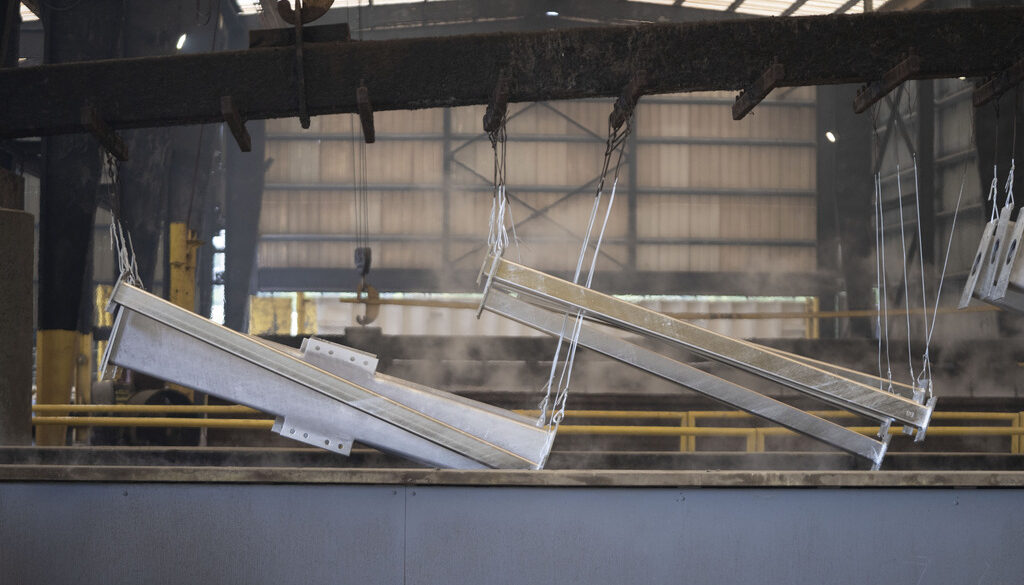
As we mentioned earlier, the actual task of hot-dip galvanizing takes minutes, but this time can vary depending on the size and shape of the products being galvanized. Small parts can be galvanized in just a few minutes, while large structures may take up to an hour to fully immerse and remove from the galvanizing bath.
Step 3: Removal from Galvanizing Bath
After the products have been galvanized, they are removed from the galvanizing bath, and any excess zinc is removed. This can be done by draining the object or even by vibrating it at a high speed.
It’s important to remember that the hot-dip galvanizing process is complete after the materials are removed from the bath. However, all hot-dipped products have to be cooled. This is usually done by immersing the products into a solution, in water, or leaving them to air-dry.
This quenching process usually takes just a few minutes, but the exact time can vary depending on the size and shape of the products being galvanized. This is a vital step when determining how long the galvanizing process takes.
Step 4: Inspection
The final step in the galvanizing process is inspection. This involves checking the products for any defects or imperfections in the zinc coating, as well as ensuring that the coating is uniform and free from any drips or runs. We repair any defects or imperfections using special galvanizing repair techniques, and then we re-inspect the products to ensure that they meet the required standards.
At South Atlantic, we take pride in the fact that every piece that goes through our hot-dipped galvanizing process passes a rigorous 25-point inspection process to ensure the highest level of service.
We adhere to the most meticulous standards of the American Society for Testing and Materials (ASTM) for hot-dip galvanizing found in ASTM A123.
These standards dictate the highest quality of the entire process, including the zinc and thickness of the coating.
Why is Galvanizing Important?
Galvanizing is an essential process for many industries, as it provides several advantages over other types of coatings.
For example, galvanized steel is more durable and longer-lasting than painted or powder-coated steel, as it is less prone to corrosion and rust. As a result, this makes it ideal for use in outdoor applications, such as bridges, buildings, and agricultural equipment.
In addition, hot-dipped galvanized steel is also more cost-effective than other types of coatings, as it requires less maintenance and replacement over time.
How South Atlantic Meets Your Timeline
Locations/Logistics
We have several plants strategically located throughout the Southeast with varying kettle sizes. This means you can easily access our plants from multiple places across the country depending on your needs.
Communication
You’ll always know at what stage your product is and when you can expect it. We believe in being open and honest about our entire process. That’s why we keep you in the loop every step of the way.
Experience
Our managers have experience with “boots on the ground.” Our leadership has a keen understanding of the entire galvanizing process. This is why we can seamlessly take your project from beginning to completion.
For More Than 50 Years, South Atlantic Has Delivered Quality Galvanizing—On Time
To become and remain an industry leader for more than five decades, you have to earn trust. And perhaps even more importantly, you have to keep that trust.
We provide the best possible service to our customers. In addition, we use only the latest technology and techniques to galvanize your products to the highest standards.
Contact us today to discuss your requirements and get a quote. Our team of experts will be happy to answer any questions you may have. We’ll provide all the information you need to make an informed decision.
Fill out our request for a quote form to get started.
We go through extensive prep steps to help ensure you get the quality product you deserve delivered on time. However, the pickling process deserves a second look. Pickling dissolves the mill scale and rust that would otherwise keep zinc from bonding properly to the steel.
To see why pickling deserves its own spotlight and how it sets up everything that follows in the galvanizing bath, we’ll take a closer look at the role of pickling in the galvanizing process.
What Is the Role of Pickling in Galvanizing?
Perhaps you already know that galvanizing is the best method of protecting your latest project from corrosion. But are you familiar with the details? As part of the hot-dip galvanizing process, your pieces go through a procedure called pickling. Pickling in galvanizing is vital to ensure your materials stand the test of time.
But what are the details behind pickling in galvanizing?
At South Atlantic, we don’t cut corners during hot-dip galvanizing. After all, for more than 50 years, we’ve stood by our clients with stellar customer service and solid results. When you work with South Atlantic, you don’t have to worry—we’ve got you covered. Want to learn more? It’s easy to get a quote.
Examining the Role of Pickling in Galvanizing
We’ll review some of the steps in hot-dip galvanizing to demonstrate why steel pickling is vital to your venture.
First, before galvanizing, the surface of the steel must be cleaned. If the steel is not as clean as possible, it can create problems with the protective zinc layer completely adhering to the steel.
This first step in the hot-dip galvanizing process is called degreasing, and it involves using a hot alkali solution. This solution will remove organic contaminants, including:
- Water-based Paint
- Grease
- Oil
- Dirt
But degreasing is only part of the preparation: We also have to use sandblasting or other techniques to remove any vinyls, asphalt or epoxies.
Pickling in Galvanizing: Ensuring the Quality of Your Product
Once these main contaminants have been removed, the steel is still not clean enough to continue to the hot molten zinc bath.
Remember: For a quality galvanized product, the steel needs to be cleaned to “base metal.” Any areas that are not perfectly clean will result in the zinc not adhering to the steel.
In addition, while degreasing removes several contaminants, there can still be iron oxide (sometimes referred to as mill scale). This needs to be removed before the process continues.
Failure to do so would mean that the protective layer of zinc oxide won’t adhere in a manner that offers the best corrosion protection (i.e., – it won’t allow the metallurgical bonding to take place between the zinc and the steel.)
Acid pickling removes this iron oxide, rust and other impurities.
The Key to Achieving the Best Coating
In order to get the best coating, we want the steel to come to us as “clean” as possible in the beginning so that degreasing, pickling and galvanizing run smoothly to give you the kind of quality you’ve come to expect from South Atlantic.
In addition, it’s important to note that some things will not come clean in the pickling process. This includes:
- Oil-Based Paints
- Lacquers
- Oil-Based Crayons or Markers
Pickling in Galvanizing: Why It’s Crucial For Your Project
Pickling is a critical step that can’t be overlooked when examining the importance of hot-dip galvanizing. To ensure your success, the entire process must be meticulously completed for you to receive the best quality.
Pickling is Only Part of the Picture: For Top Quality, Explore How South Atlantic Has You Covered
At South Atlantic, our rigorous quality control process meets convenient on-time delivery to give you not only a quality product but one that arrives with no hidden surcharges.
We’ve built our business on excellence, and that’s why we’re the Southeast’s leading galvanizer, trusted by national brands for 50 years. Ready to get started? Just contact us for a quote to see how we’ve got you covered.
Key Takeaways:
- Hot-dip galvanizing coats steel or iron with zinc to protect against corrosion, and the actual dipping takes minutes to hours, but full project turnaround is typically around three days (or 24 hours if expedited).
- The process has four main steps: preparation (degreasing, pickling, fluxing), the zinc bath immersion, removal/quenching, and a final inspection.
- Pickling is a critical prep step that uses acid to strip rust, mill scale, and other impurities so zinc can properly bond to the steel’s “base metal.”
- Degreasing (using a hot alkali solution) removes organic contaminants like grease, oil, dirt, and paint, but doesn’t remove iron oxide/mill scale — that’s pickling’s job.
- Some contaminants, such as oil-based paints, lacquers, and oil-based crayons/markers, won’t come off in pickling and must be addressed separately.
- Galvanized steel is more durable and cost-effective long-term than painted or powder-coated steel because it resists corrosion and needs less maintenance.
- South Atlantic differentiates itself through multiple strategically located plants, transparent communication throughout the process, and 50+ years of hands-on industry experience.
—-
Source:
ASTM International, “Standard Specification for Zinc (Hot-Dip Galvanized) Coatings on Iron and Steel Products,” https://store.astm.org/a0123_a0123m-17.html